

MMSx-SCAN
Eight scored domains, BFIS™ flaw grading and a Movement Intelligence Index out of 100 — the systematic clinical assessment, scored parameter by parameter on the phone and printed as an official report.
What is MMSx-SCAN?
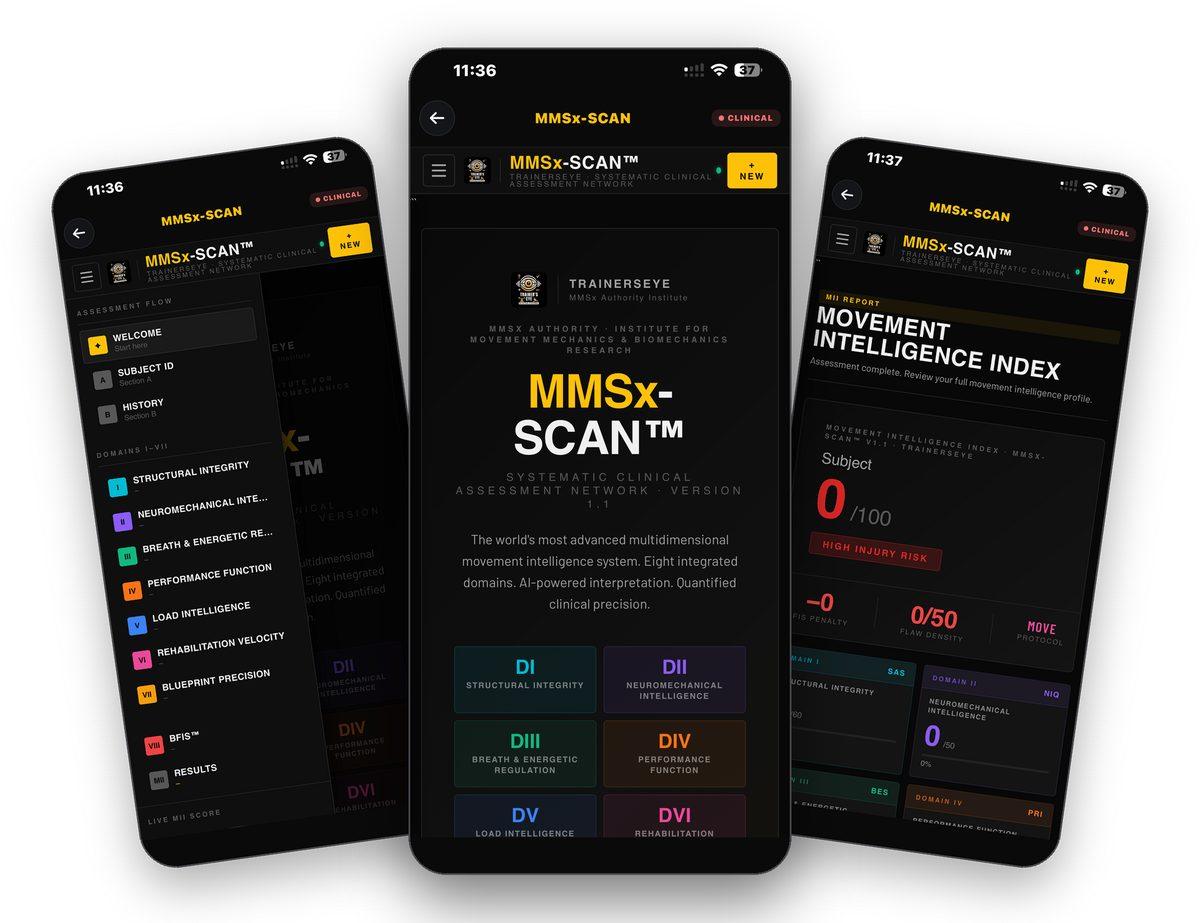
MMSx-SCAN™ is the TrainersEye Systematic Clinical Assessment Network, version 1.1 — a multidimensional movement intelligence assessment. It runs as a flow: Section A Subject ID, Section B History, then eight domains — Structural Integrity, Neuromechanical Intelligence, Breath & Energetic Regulation, Performance Function, Load Intelligence, Rehabilitation Velocity, Blueprint Precision and BFIS™ Flaw Intelligence — each scored parameter by parameter from 0 to 10 with a clinical observation, and each detected flaw graded 1 to 5. Results combines them into the Movement Intelligence Index out of 100 with its band, the BFIS penalty, the flaw density and the recommended protocol, and prints as the Movement Intelligence Assessment Report.
A flow, not a form
Welcome, Subject ID, History, Domains I–VII, BFIS™, Results — the menu walks the assessment in order and carries the live MII.
Scored parameter by parameter
Every parameter is 0–10 with a clinical observation; each domain has its own scale — SAS /60, then NIQ, BES, PRI, LIS, RVS and EIS /50.
Flaws graded
BFIS™ identifies, classifies and grades each detected fault 1–5 (– if absent) and penalises the index.
One index, one report
The MII out of 100 with its band and protocol, a card per domain, and the official report with Sections A and B.
Where to find it
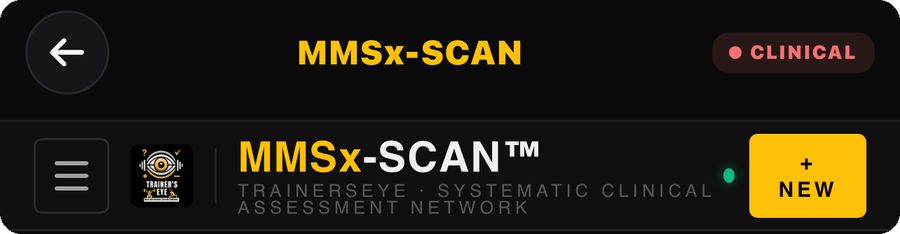
Open the TrainersEye app, go to the Dashboard and tap MMSx-SCAN. It is a Clinical-plan tool — the CLINICAL badge sits beside the title.
This guide in thirteen steps
Open the tool
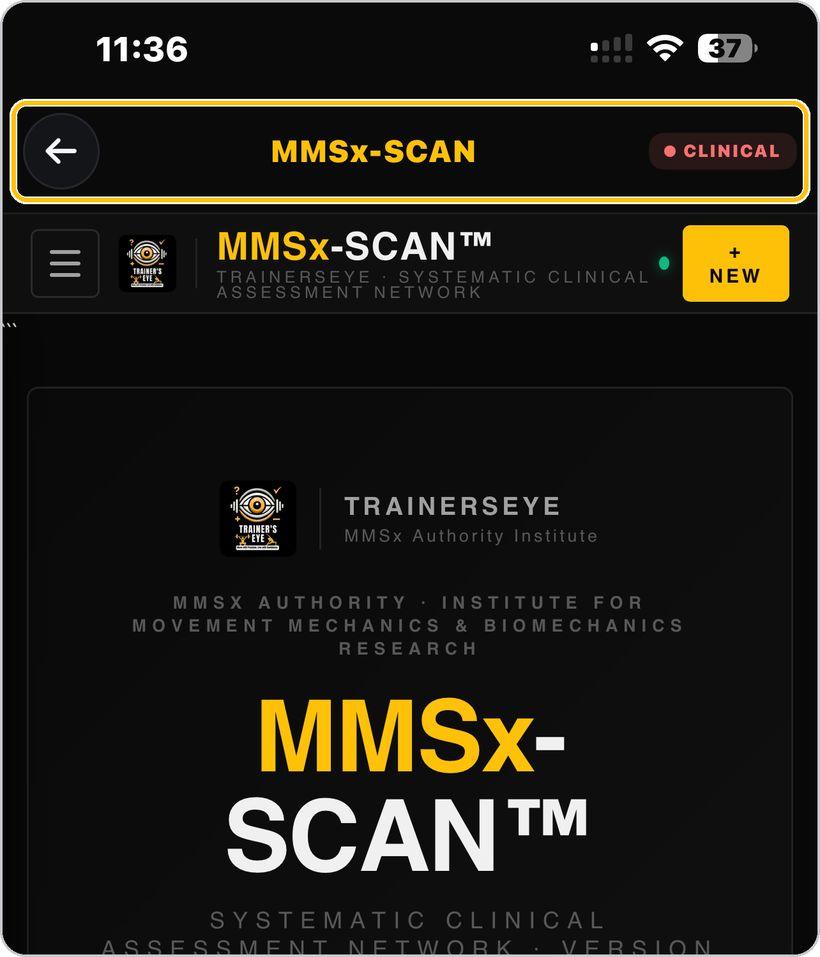
From the Dashboard, tap MMSx-SCAN. It is a Clinical-plan tool — the CLINICAL badge sits beside the title. The tool bar beneath reads MMSx-SCAN™ — TrainersEye · Systematic Clinical Assessment Network.
The tool bar
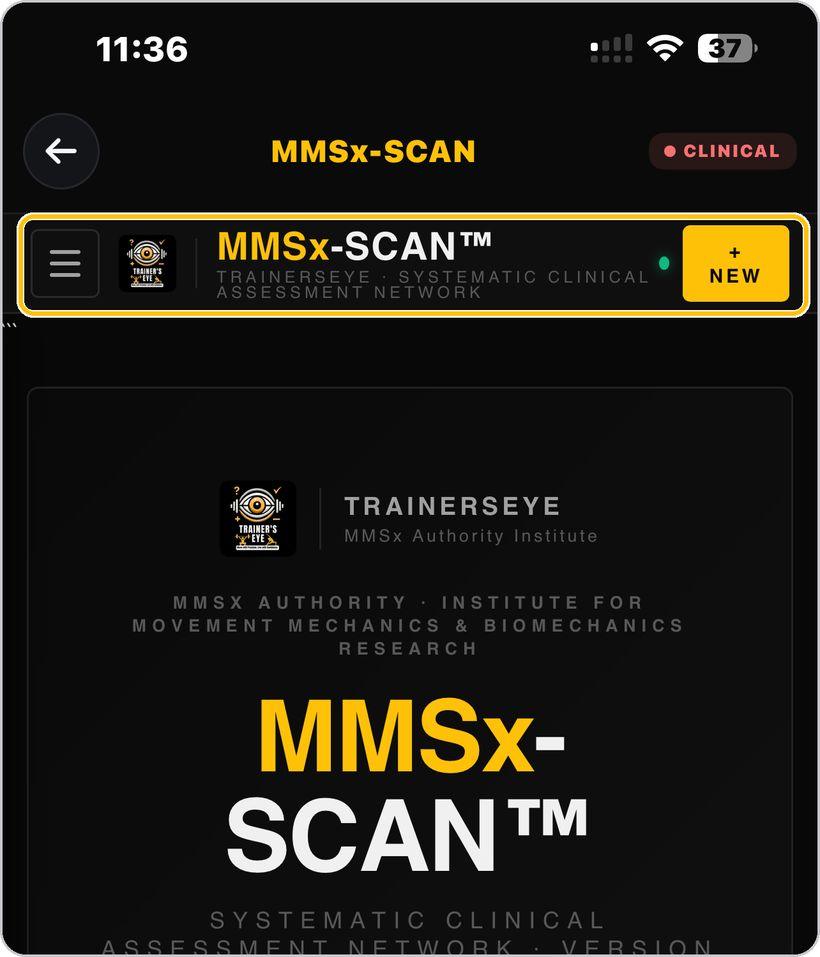
The bar carries the ≡ menu, the Trainer's Eye mark, the tool name, a green live dot and + New. ≡ opens the assessment flow; + New starts a new assessment.
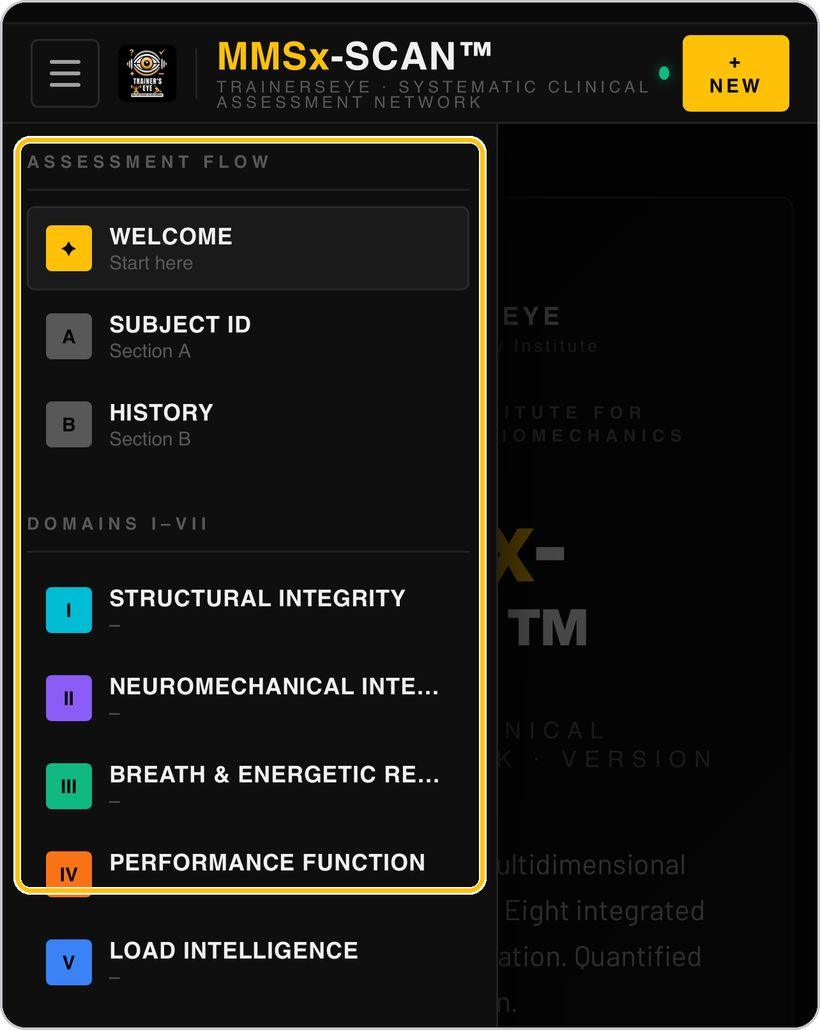
The assessment flow
The menu is the flow: Welcome (start here), A Subject ID, B History; Domains I–VII — Structural Integrity, Neuromechanical Intelligence, Breath & Energetic Regulation, Performance Function, Load Intelligence, Rehabilitation Velocity, Blueprint Precision; VIII BFIS™; MII Results. The Live MII score sits at the foot of the menu.
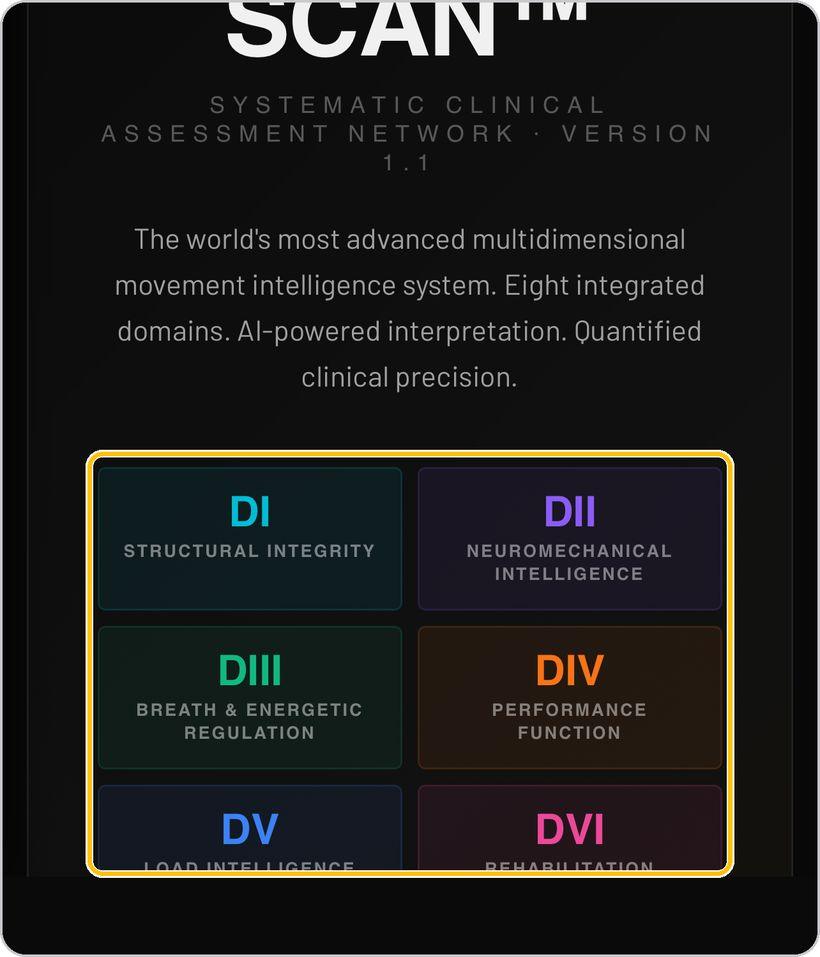
Welcome: the eight domains
Welcome frames the assessment — TrainersEye · MMSx Authority Institute, MMSx-SCAN™, Systematic Clinical Assessment Network, version 1.1: eight integrated domains, AI-powered interpretation, quantified clinical precision — and shows the domain tiles: DI Structural Integrity, DII Neuromechanical Intelligence, DIII Breath & Energetic Regulation, DIV Performance Function, DV Load Intelligence, DVI Rehabilitation Velocity, DVII Blueprint Precision and DVIII BFIS™.
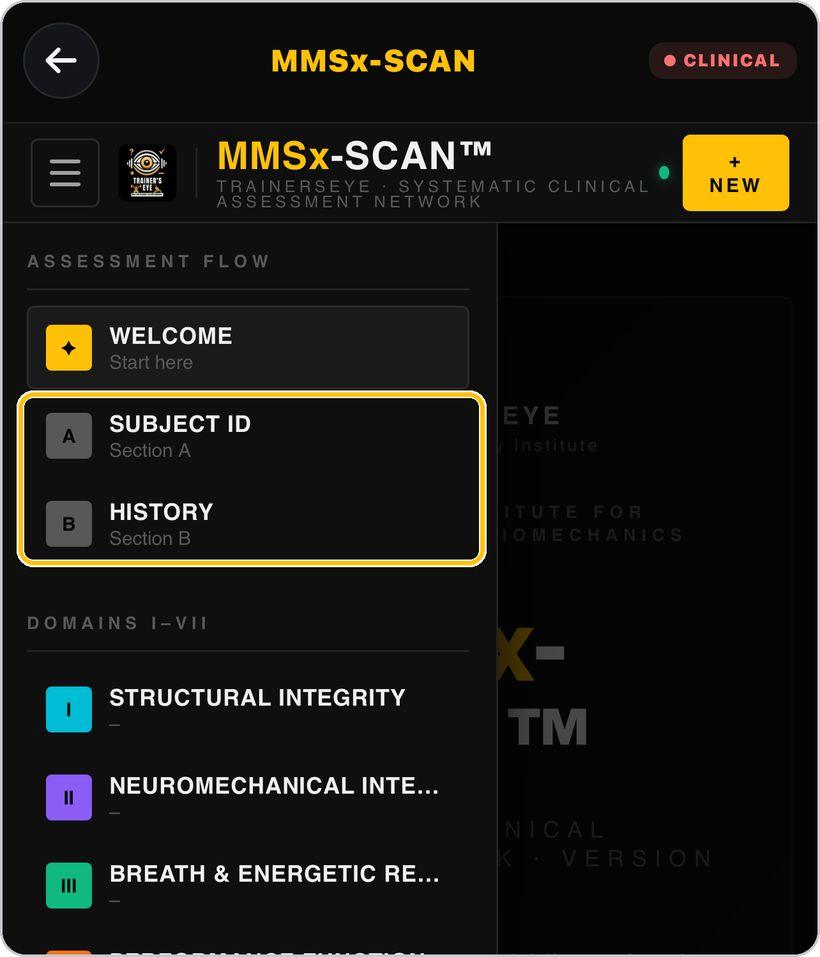
Section A and Section B
Subject ID records the subject: full name, MMSx ID, type (such as Performance), age, gender, dominant side, height, weight and occupation. History records the clinical context: pain VAS, sleep, training per week, chief complaint, previous injuries, surgery, limitations and physio history. Both print as Sections A and B of the report.
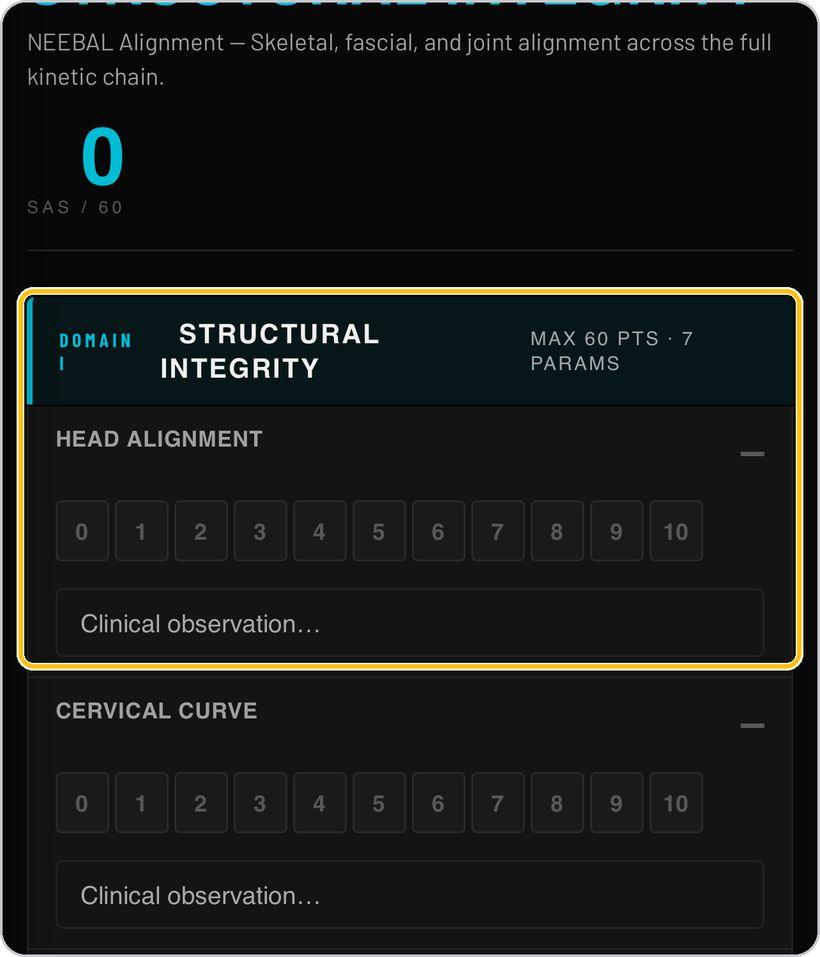
Score a domain
Each domain opens on its title, description and running score — Domain I Structural Integrity, NEEBAL alignment, 0 SAS / 60 — then its parameter card: Max 60 pts · 7 params. Score each parameter 0 to 10 and write the clinical observation beneath it — Head alignment, Cervical curve, Thoracic curve and on. The domain score updates as you tap.
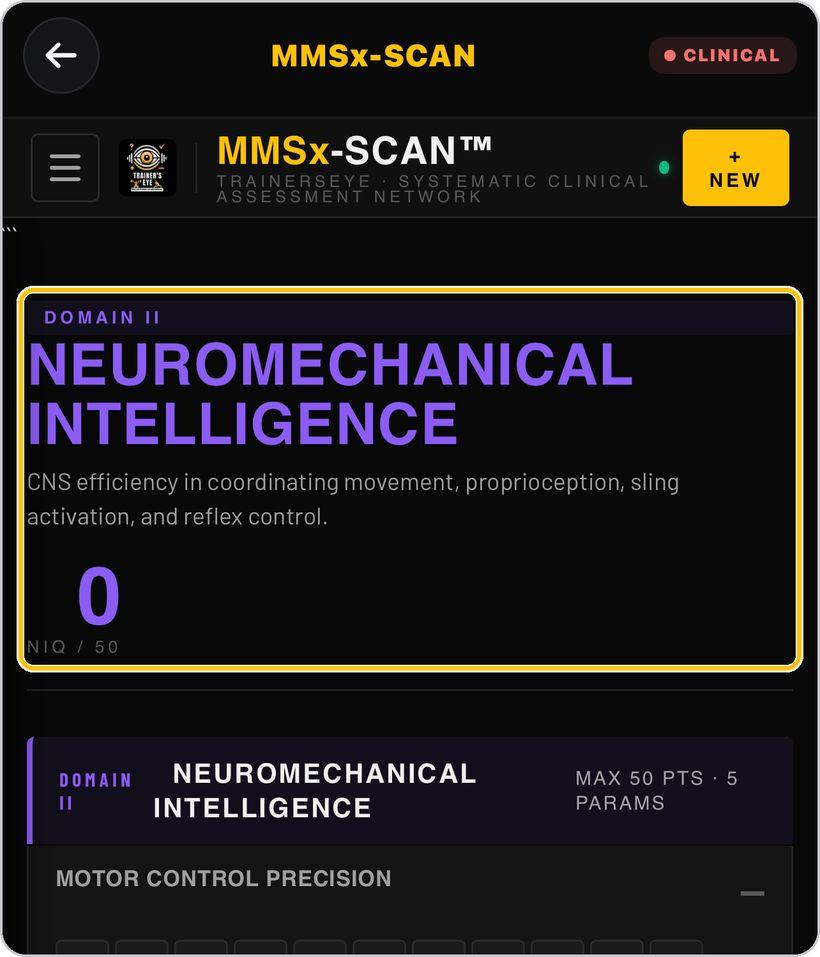
Domain II
Neuromechanical Intelligence — CNS efficiency in coordinating movement, proprioception, sling activation and reflex control — NIQ / 50, five parameters: Motor control precision, Proprioceptive stability, Reflex control and on.
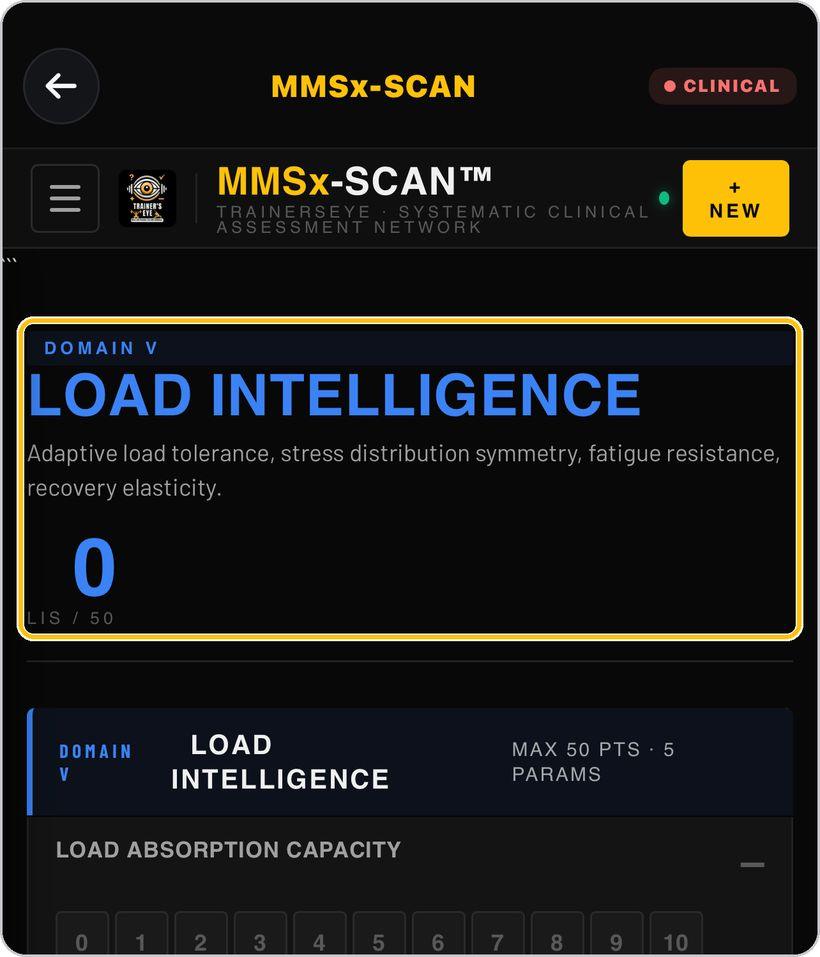
Domain V
Load Intelligence — adaptive load tolerance, stress distribution symmetry, fatigue resistance, recovery elasticity — LIS / 50, five parameters: Load absorption capacity, Stress distribution symmetry, Fatigue resistance and on.
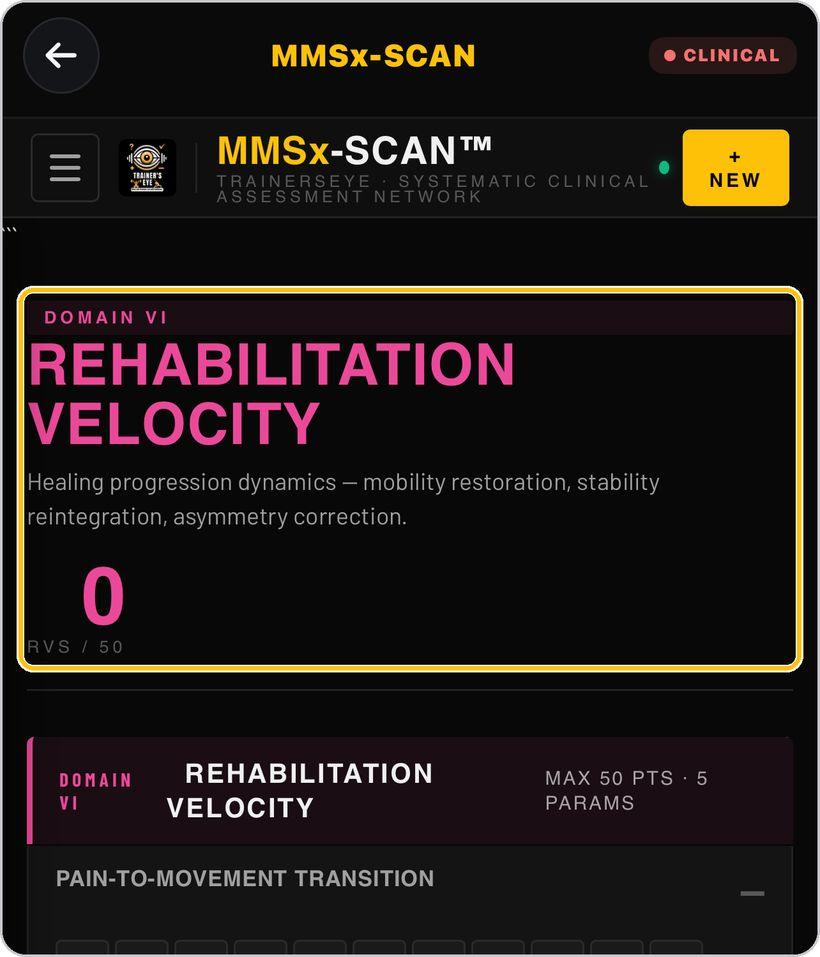
Domain VI
Rehabilitation Velocity — healing progression dynamics: mobility restoration, stability reintegration, asymmetry correction — RVS / 50, five parameters: Pain-to-movement transition, Mobility restoration, Stability reintegration and on.
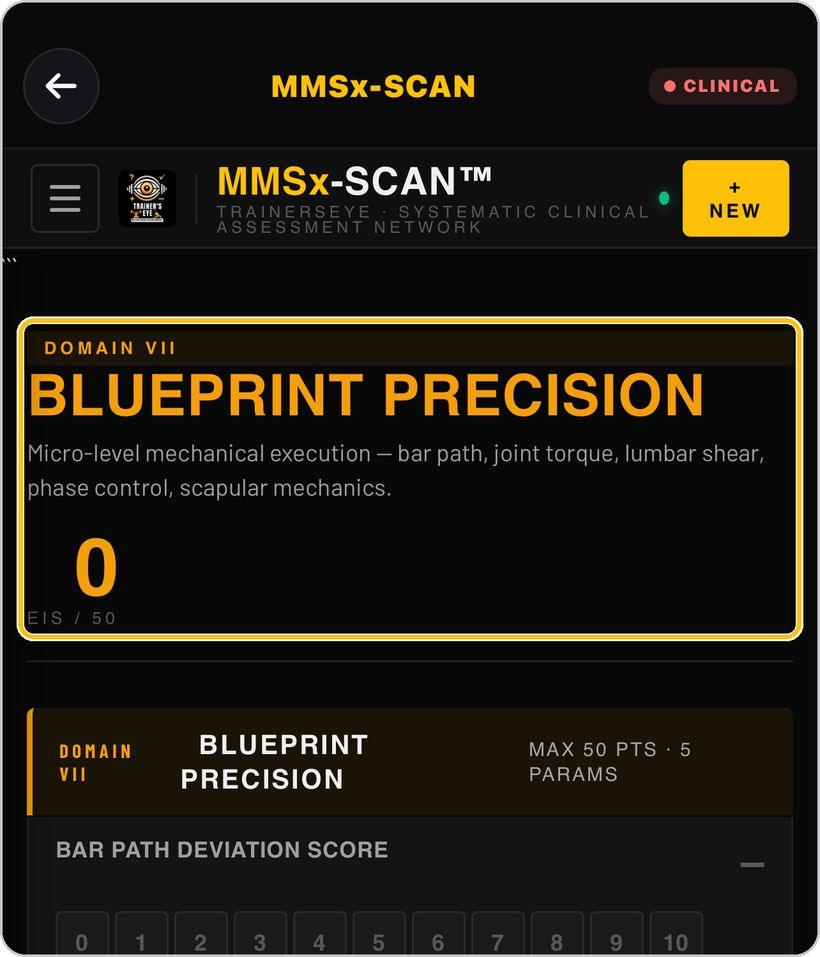
Domain VII
Blueprint Precision — micro-level mechanical execution: bar path, joint torque, lumbar shear, phase control, scapular mechanics — EIS / 50, five parameters: Bar path deviation score, Joint torque irregularity, Lumbar shear strain index and on.
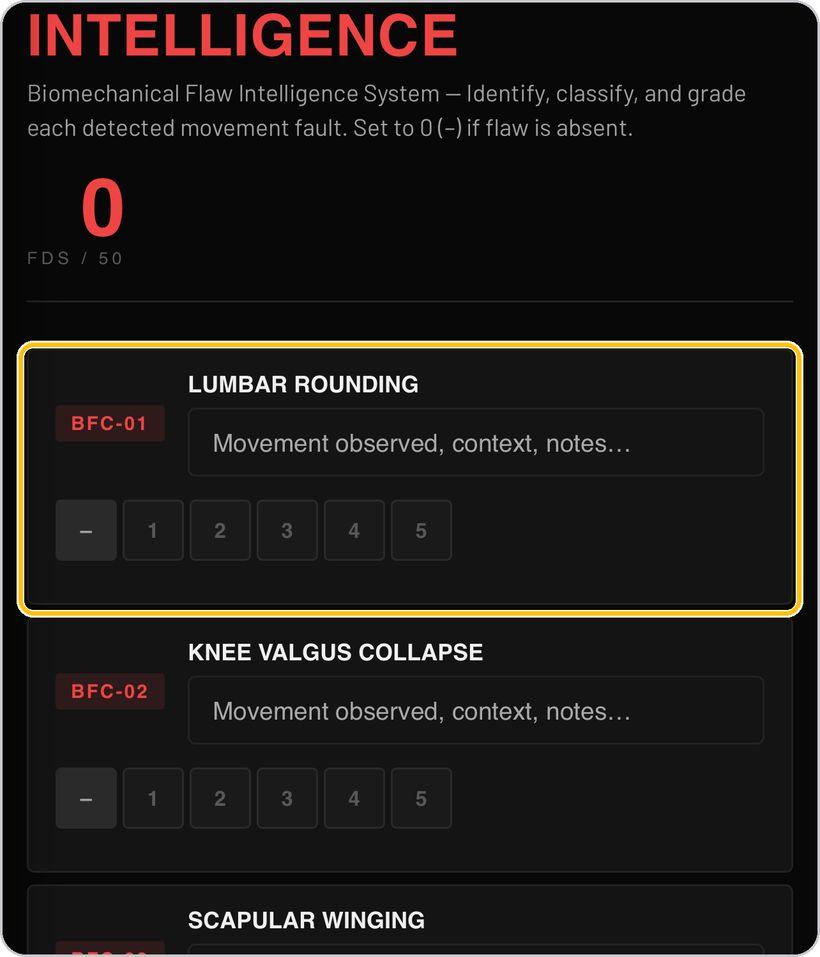
Domain VIII: BFIS™
BFIS™ Flaw Intelligence — the Biomechanical Flaw Intelligence System: identify, classify and grade each detected movement fault, FDS / 50. Each flaw carries its code — BFC-01 Lumbar rounding, BFC-02 Knee valgus collapse, BFC-03 Scapular winging, Hip hinge failure and on — a notes field for the movement observed and its context, and a grade 1 to 5; leave – if the flaw is absent.
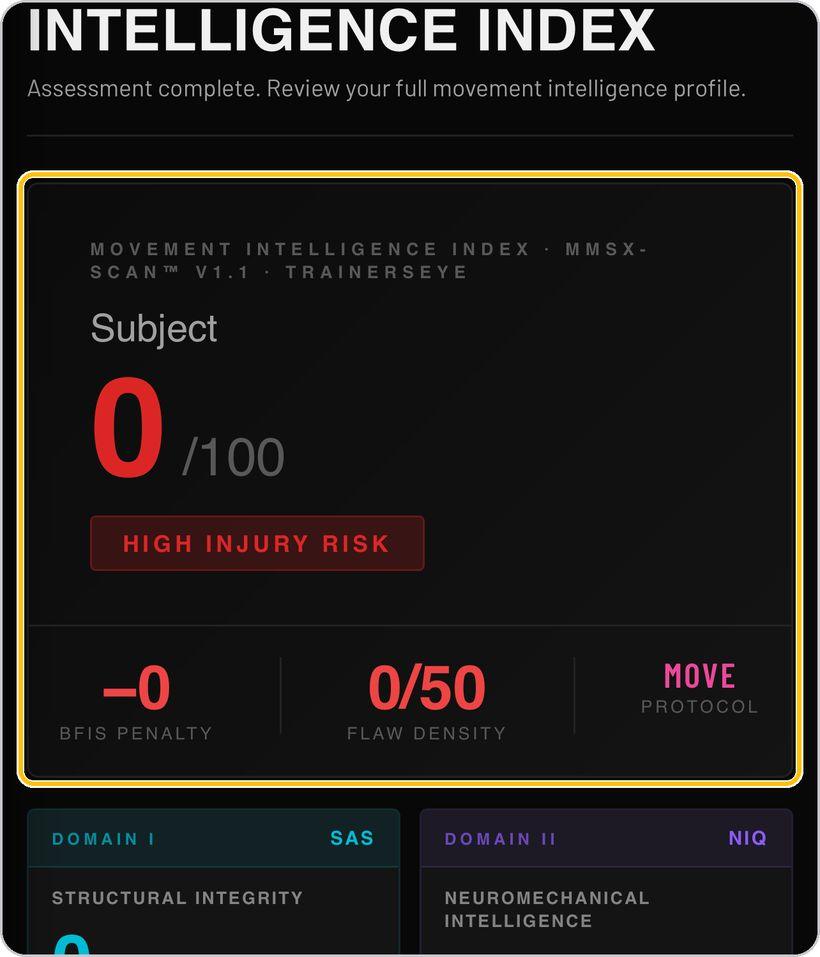
Results: the Movement Intelligence Index
Results opens the MII report: the Movement Intelligence Index out of 100 with its band — High injury risk at the bottom, Dysfunction present at 50 in the sample report — the BFIS penalty, the flaw density FDS / 50 and the recommended protocol, MOVE. Assessment complete: review the full movement intelligence profile.
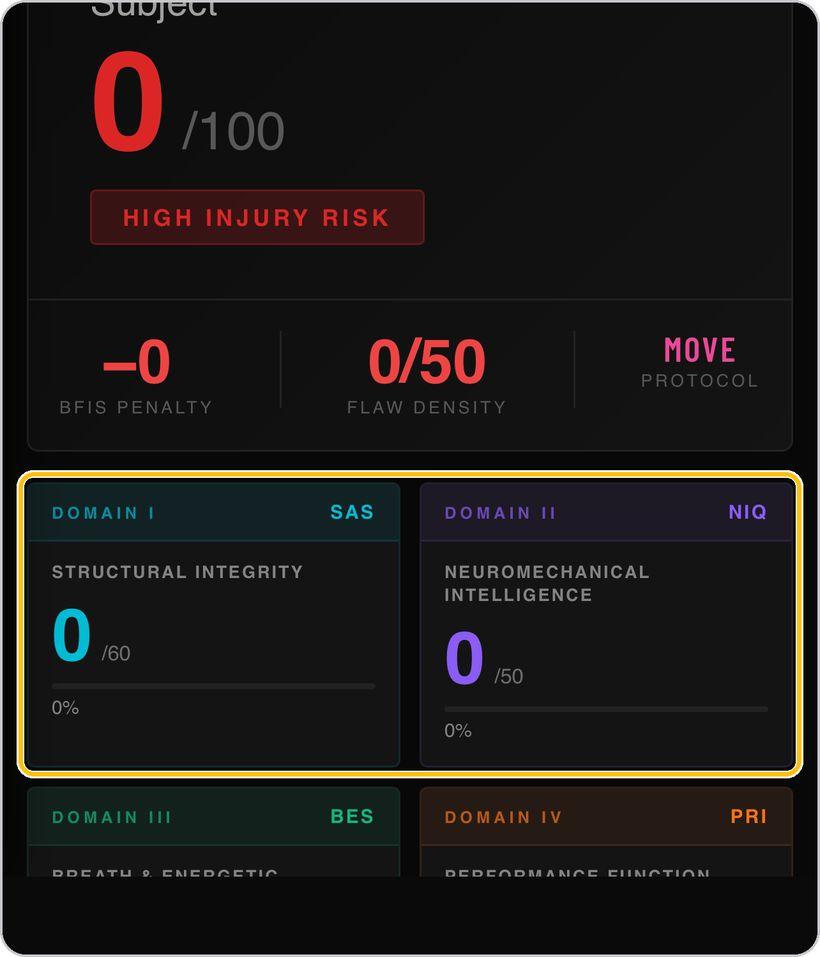
Domain cards and the report
Beneath the index, one card per domain — Domain I SAS 0/60 0%, Domain II NIQ /50 and on — with its score, its maximum and a percentage bar. The report prints as the Movement Intelligence Assessment Report, Form MMSX-SCAN-CF-01: a header with date, IMSO number and assessor, the MII card with band, subject, protocol, BFIS penalty and FDS, the seven domain bars, and Sections A and B.
You're ready
That's it. Tap + New, fill Sections A and B, score the domains and read the index.
Reading the assessment report
The Movement Intelligence Assessment Report, Form MMSX-SCAN-CF-01, as it prints. Here is what each part means.
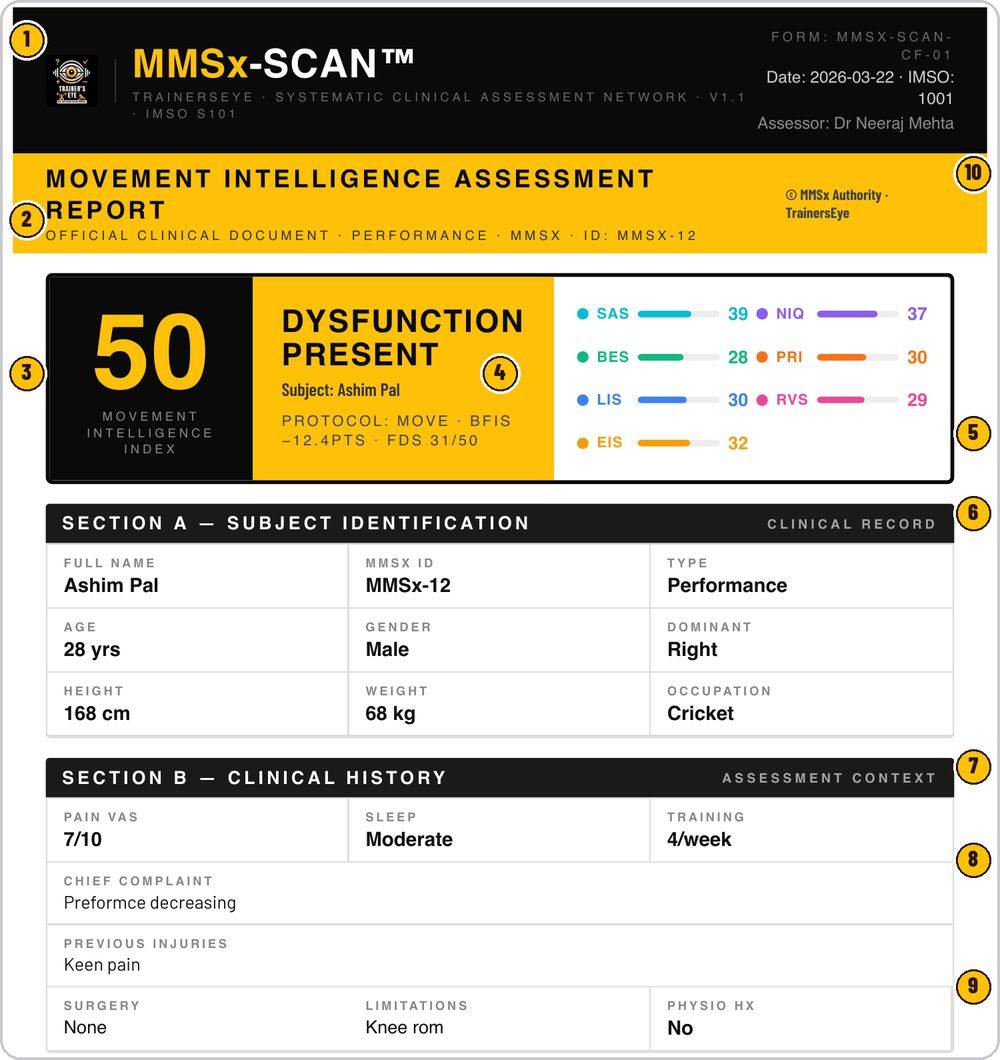
MMSx-SCAN™ · TrainersEye · Systematic Clinical Assessment Network · V1.1 · IMSO S101, with the form number, date, IMSO number and assessor.
Movement Intelligence Assessment Report — official clinical document, the assessment type and the subject's MMSx ID.
The MII out of 100.
The MII band (Dysfunction present), the subject's name, the recommended protocol (MOVE), the BFIS penalty in points and the flaw density FDS /50.
The seven domain scores — SAS, NIQ, BES, PRI, LIS, RVS, EIS — each on its bar.
Full name, MMSx ID, type, age, gender, dominant side, height, weight, occupation.
Pain VAS, sleep, training per week.
Written in the assessor's words at Section B.
The remaining history fields.
© MMSx Authority · TrainersEye.
MMSx-SCAN is part of TrainersEye
Support: support@trainerseye.com · trainerseye.com
MMSx-SCAN™ · MMSx Authority Institute for Movement Mechanics & Biomechanics Research · Backed by MMSx Authority Institute
Clinical assessment tool for trained assessors — the MII, its bands and the recommended protocol are decision support built from the assessor's own scores; they do not replace clinical judgement or medical diagnosis.