
Open Education
The MoPro Codex Library — modules, monographs, books, slide decks, exercise comparisons, IMSO blueprints, articles and research readings — read online, print to A4, cite with a DOI.
What is Open Education?
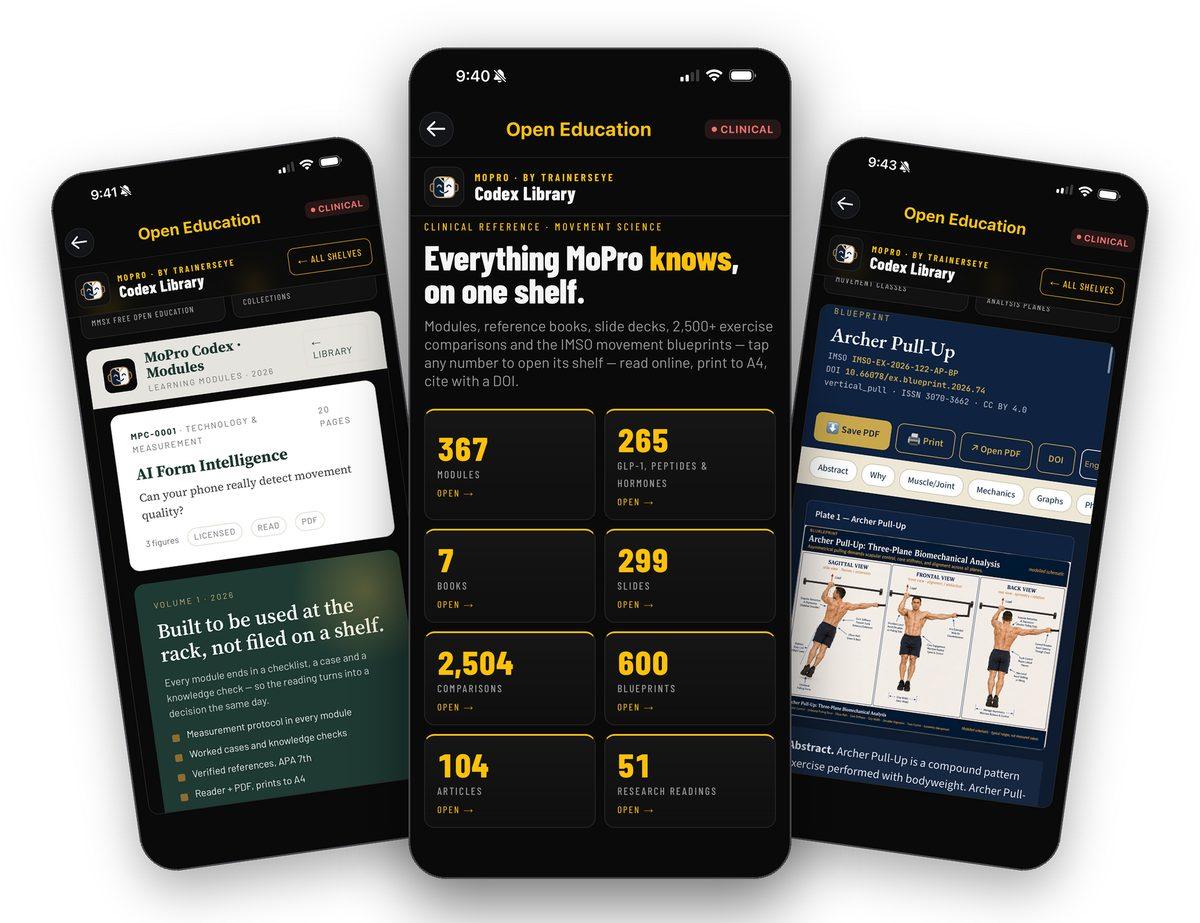
Open Education is the MoPro Codex Library — everything MoPro knows, on one shelf. Eight shelves: 367 learning modules, 265 GLP-1, peptide and hormone modules, seven reference books, 299 slide decks, 2,504 exercise comparison decision documents, 600 IMSO-registered movement blueprints, 104 articles and 51 research reading collections. Tap any number to open its shelf; read online, print to A4, cite with a DOI. Comparisons and blueprints read in EN · ES · HI · AR, and the free MMSx titles carry CC BY 4.0. Published by MMSx Authority Institute.
Eight shelves
Modules, GLP-1 Peptides & Hormones, Books, Slides, Comparisons, Blueprints, Articles and Research Readings — each with its count on the door.
Read, print, cite
Every shelf reads online, prints to A4 and carries a DOI to cite; the free MMSx titles are CC BY 4.0.
Decision documents
2,504 exercise comparisons and 600 blueprints — load vectors, torque, three-plane analysis and decision support, in four languages.
Editorial layers
Articles co-authored with practising professionals, and research readings of 1,020 open-licence papers, read closely.
Where to find it
Open the TrainersEye app, go to the Dashboard and tap Open Education. It is a Clinical-plan tool — the CLINICAL badge sits beside the title.
This guide in thirteen steps
Open the tool
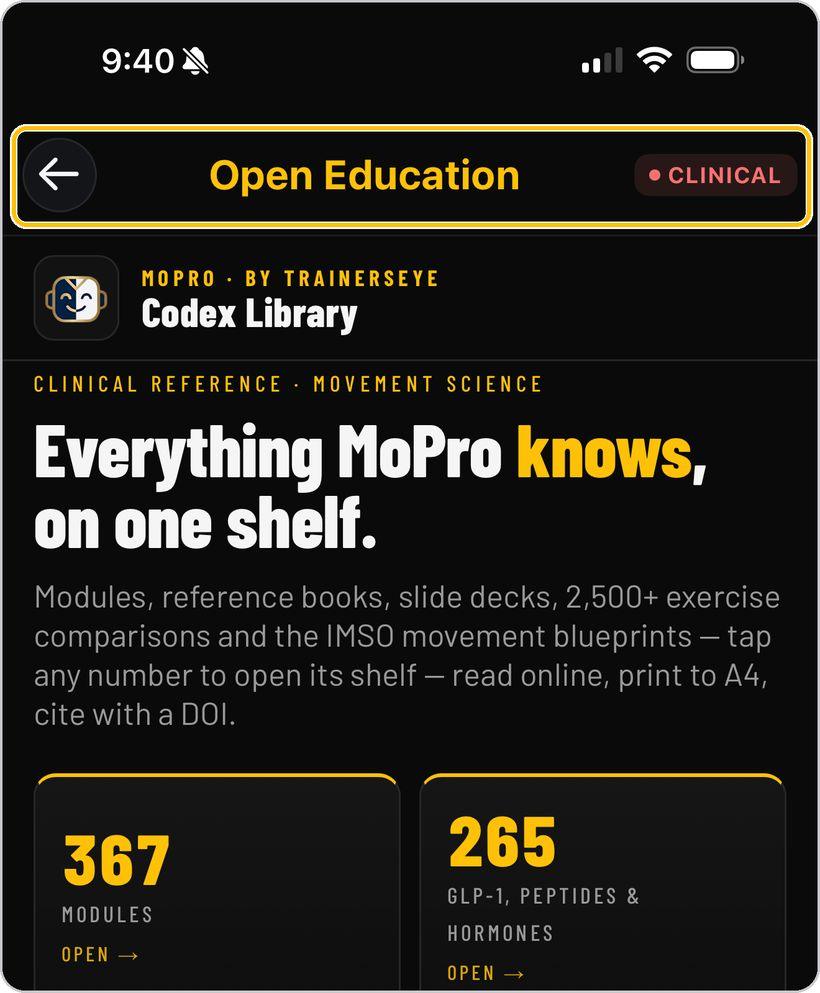
From the Dashboard, tap Open Education. It is a Clinical-plan tool — the CLINICAL badge sits beside the title. The bar beneath reads MoPro · by TrainersEye — Codex Library, with the MoPro mark.
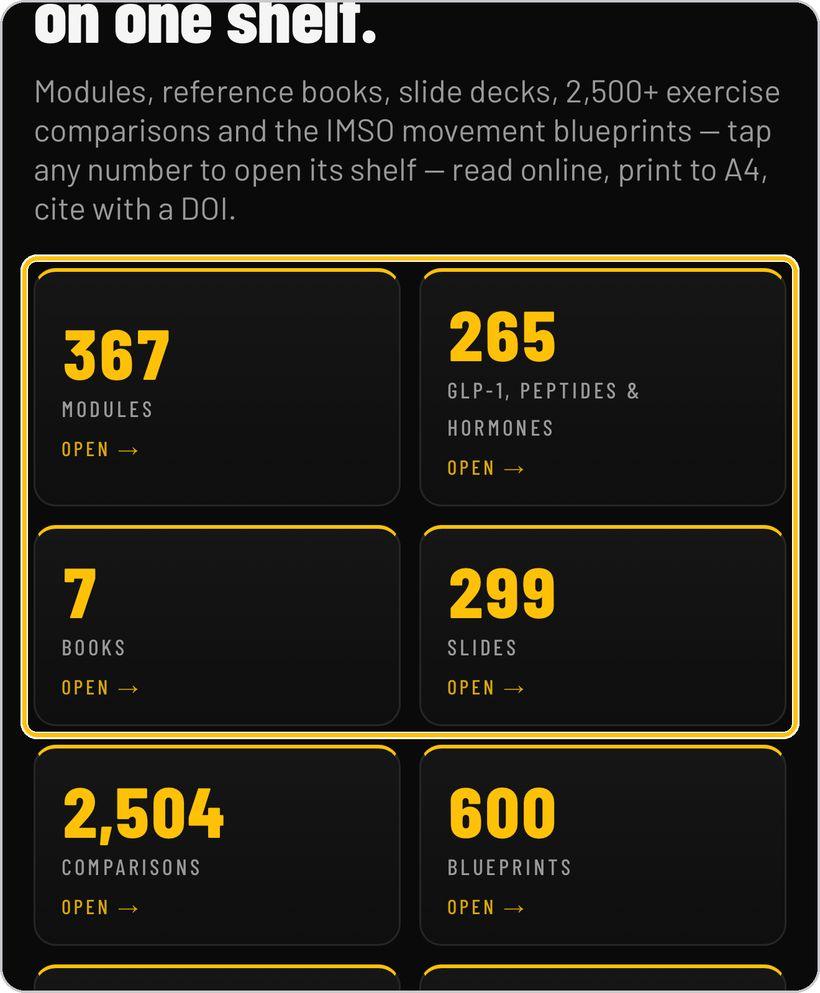
The shelves
Everything MoPro knows, on one shelf: 367 Modules, 265 GLP-1, Peptides & Hormones, 7 Books, 299 Slides, 2,504 Comparisons, 600 Blueprints, 104 Articles and 51 Research Readings. Tap any number to open its shelf — read online, print to A4, cite with a DOI.
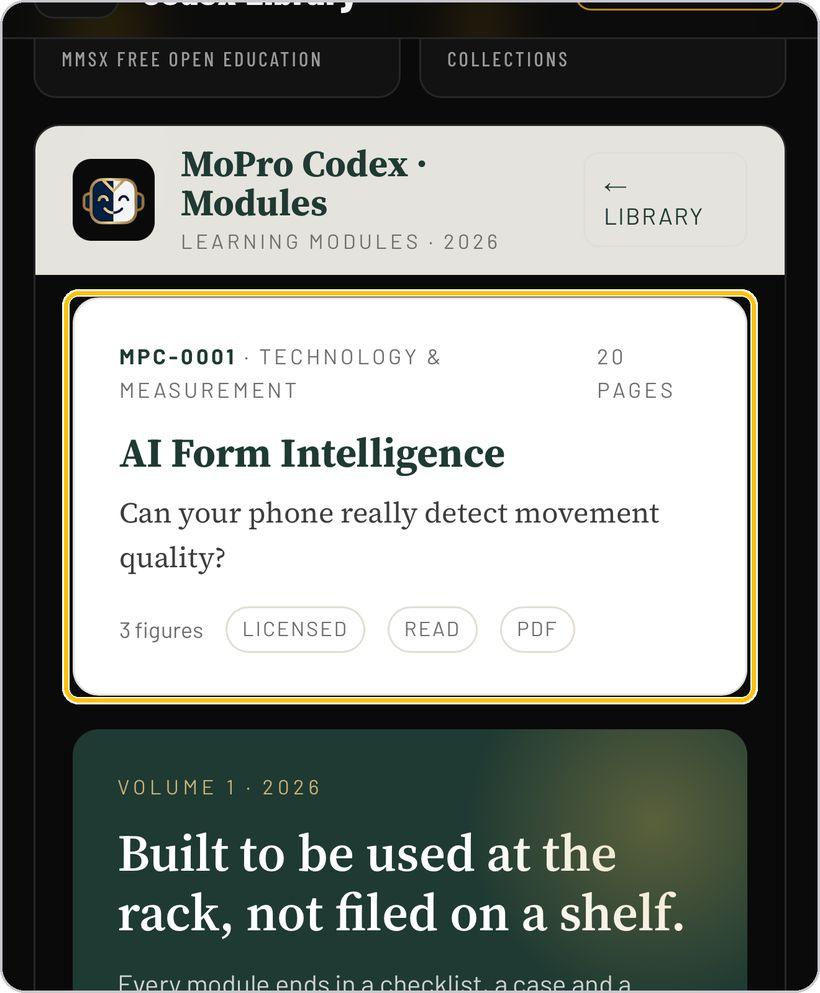
Modules
Modules opens MoPro Codex · Modules — learning modules, 2026 — under the MMSx Free Open Education and Collections tabs. Each card carries the module code and domain (MPC-0001 · Technology & Measurement), its pages, title and question, its figure count and three buttons: Licensed, Read and PDF. Every module ends in a checklist, a case and a knowledge check, with a measurement protocol, verified APA 7th references and a reader plus PDF that prints to A4.
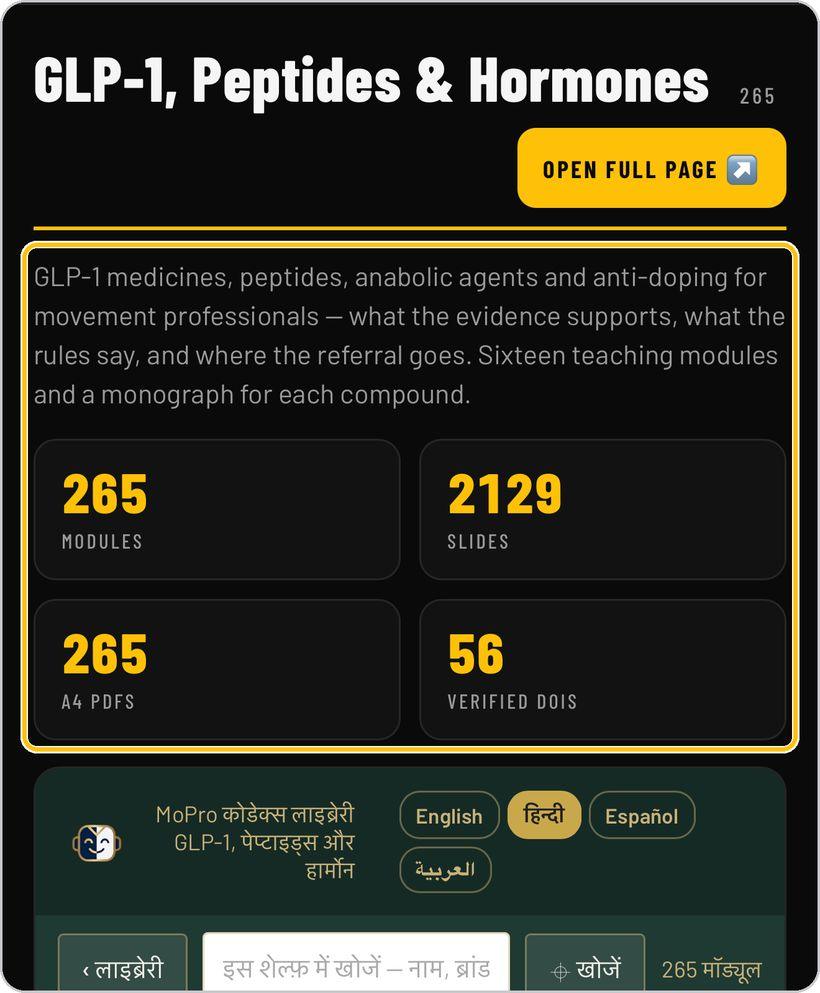
GLP-1, Peptides & Hormones
The pharmacology shelf: GLP-1 medicines, peptides, anabolic agents and anti-doping for movement professionals — what the evidence supports, what the rules say and where the referral goes. Sixteen teaching modules and a monograph for each compound: 265 modules, 2,129 slides, 265 A4 PDFs, 56 verified DOIs. The shelf's own reader below has English, हिन्दी, Español and العربية and a search by name or brand.
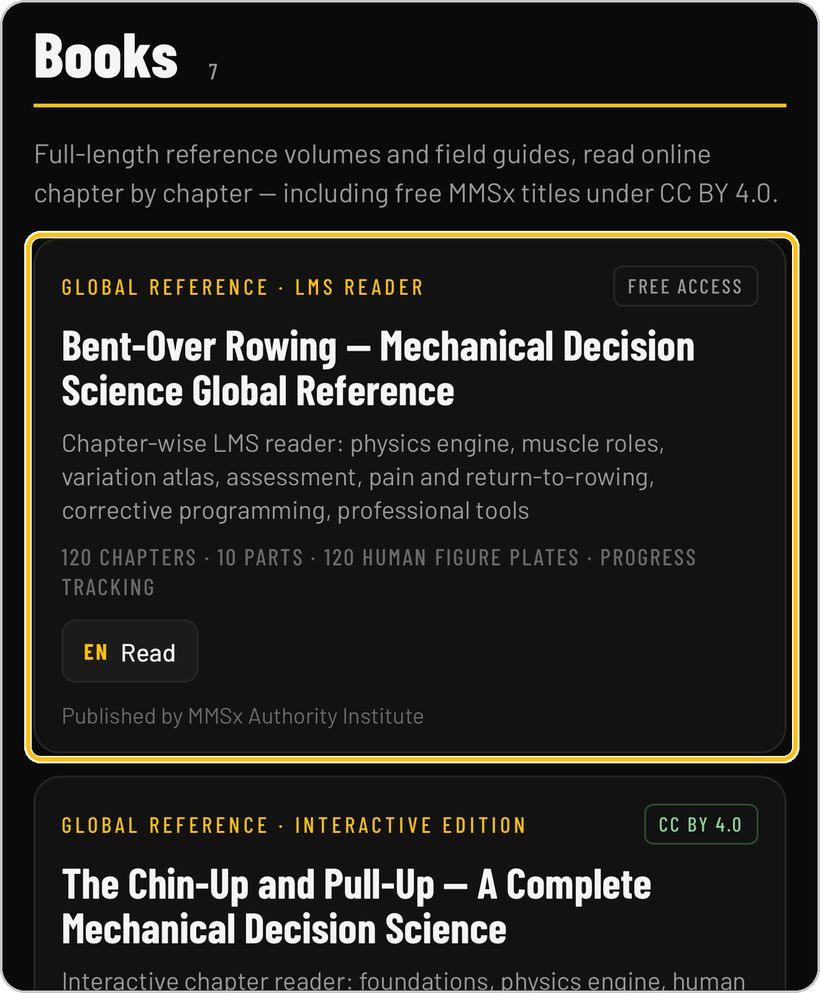
Books
Seven full-length reference volumes and field guides, read online chapter by chapter, including free MMSx titles under CC BY 4.0. Each card gives the edition — Global Reference · LMS Reader, or Interactive Edition — its access (Free access or CC BY 4.0), its chapters, parts, figure plates, progress tracking and DOI, then EN Read and EN DOI. Published by MMSx Authority Institute.
Slides
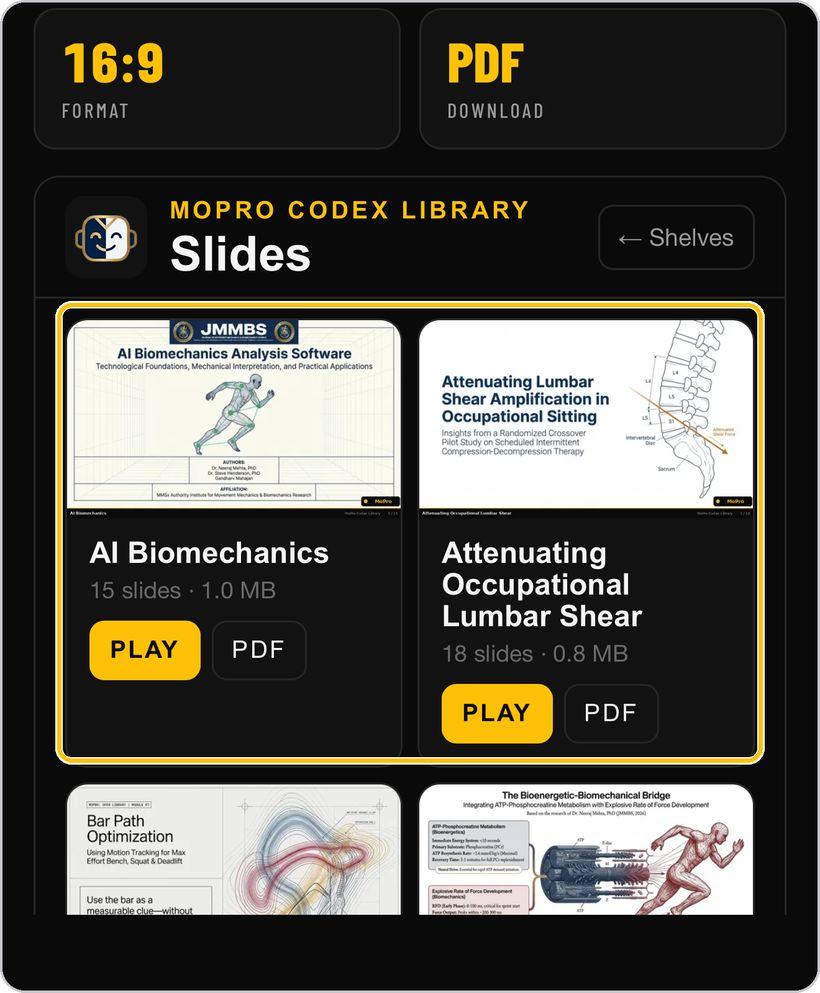
Illustrated slide decks, one concept per deck: 299 decks, 1,992 slides, 16:9, PDF download. Swipe or use the arrow keys, go fullscreen, or download the PDF. Each card shows the deck's cover, its slide count and size, then Play and PDF.
Comparisons
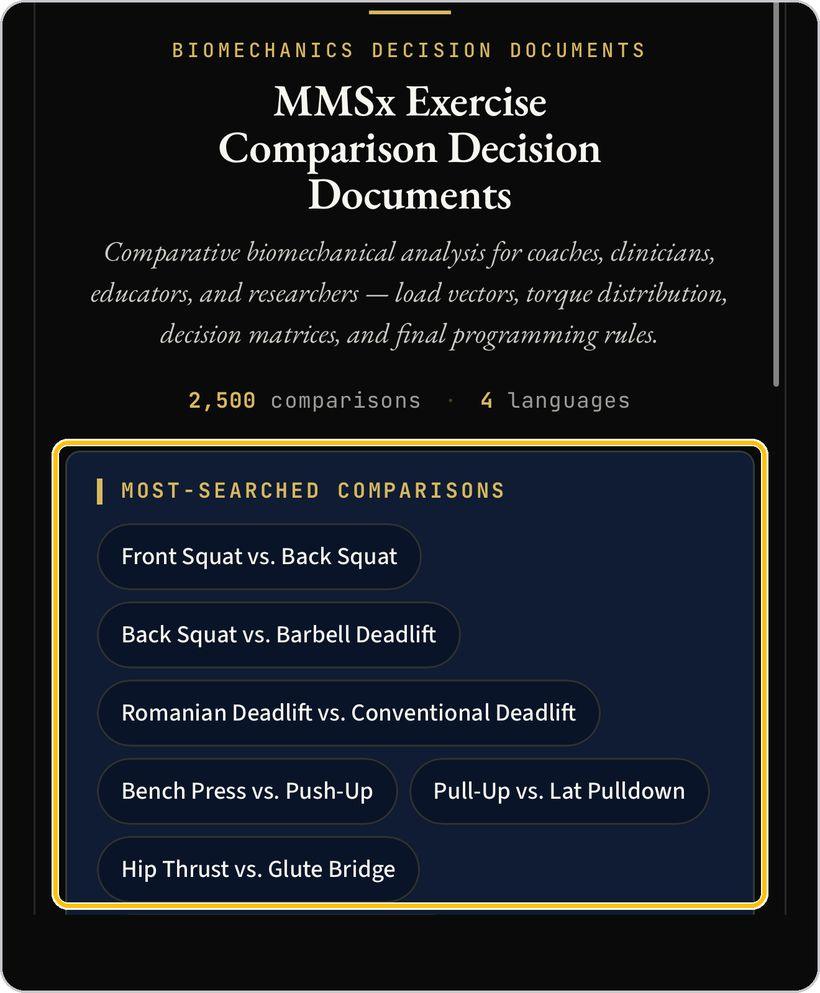
2,504 exercise comparison decision documents in four languages, across 11 muscle axes and 6 physics dimensions: comparative biomechanical analysis for coaches, clinicians, educators and researchers — load vectors, torque distribution, decision matrices and final programming rules. Start from the most-searched comparisons — Front Squat vs. Back Squat, Back Squat vs. Barbell Deadlift, Romanian vs. Conventional Deadlift, Bench Press vs. Push-Up, Pull-Up vs. Lat Pulldown, Hip Thrust vs. Glute Bridge — or browse.
Read a comparison
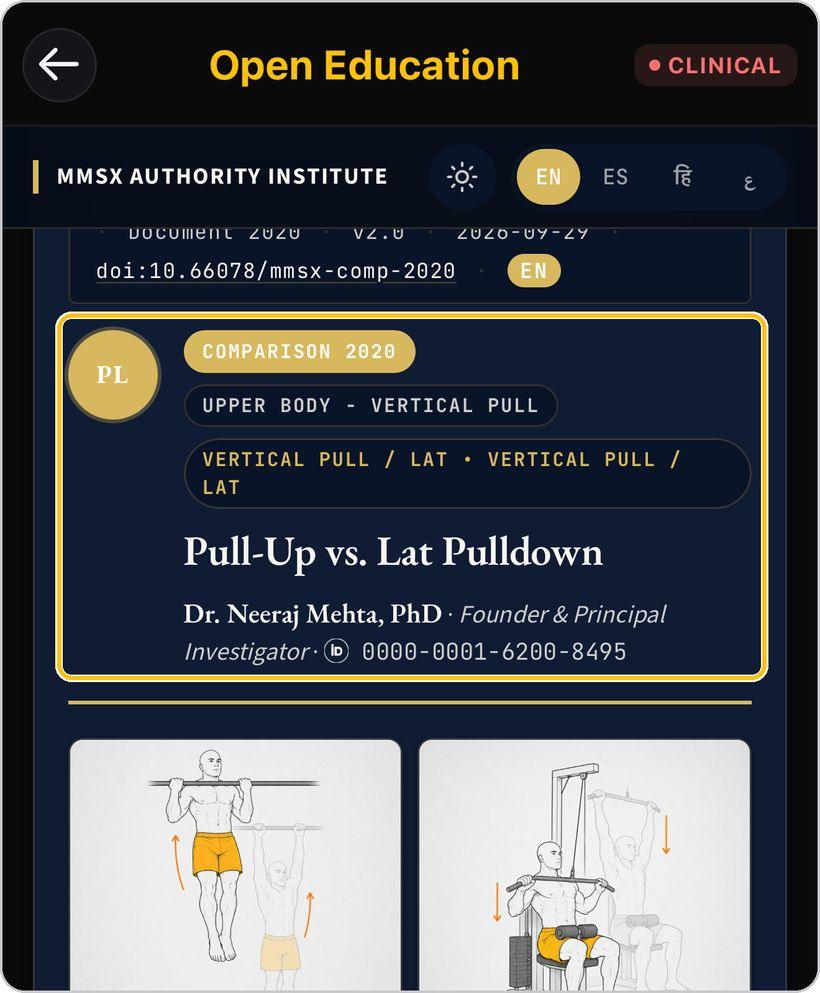
A comparison opens as a decision document: its number, version, date and DOI (doi:10.66078/mmsx-comp-2020), the region and movement-class chips, the title — Pull-Up vs. Lat Pulldown — the author line with ORCID, then the A and B illustrations. Print / PDF makes the A4 document; the Coach · Professor / Educator · Researcher switch sets the reading; the feature table follows — name, load-vector difference, COM / displacement strategy and on.
Blueprints
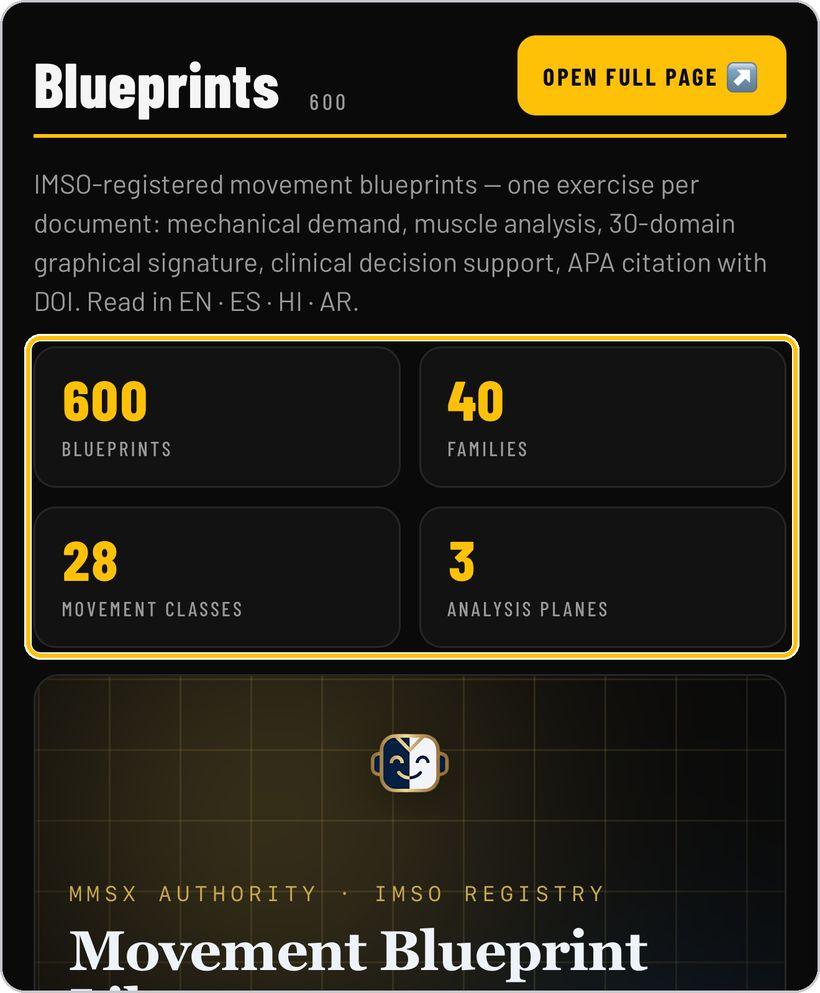
600 IMSO-registered movement blueprints across 40 families, 28 movement classes and 3 analysis planes — one exercise per document: mechanical demand, muscle analysis, a 30-domain graphical signature, clinical decision support and an APA citation with DOI, in EN · ES · HI · AR. The Movement Blueprint Library sits below — MMSx Authority · IMSO Registry.
Read a blueprint
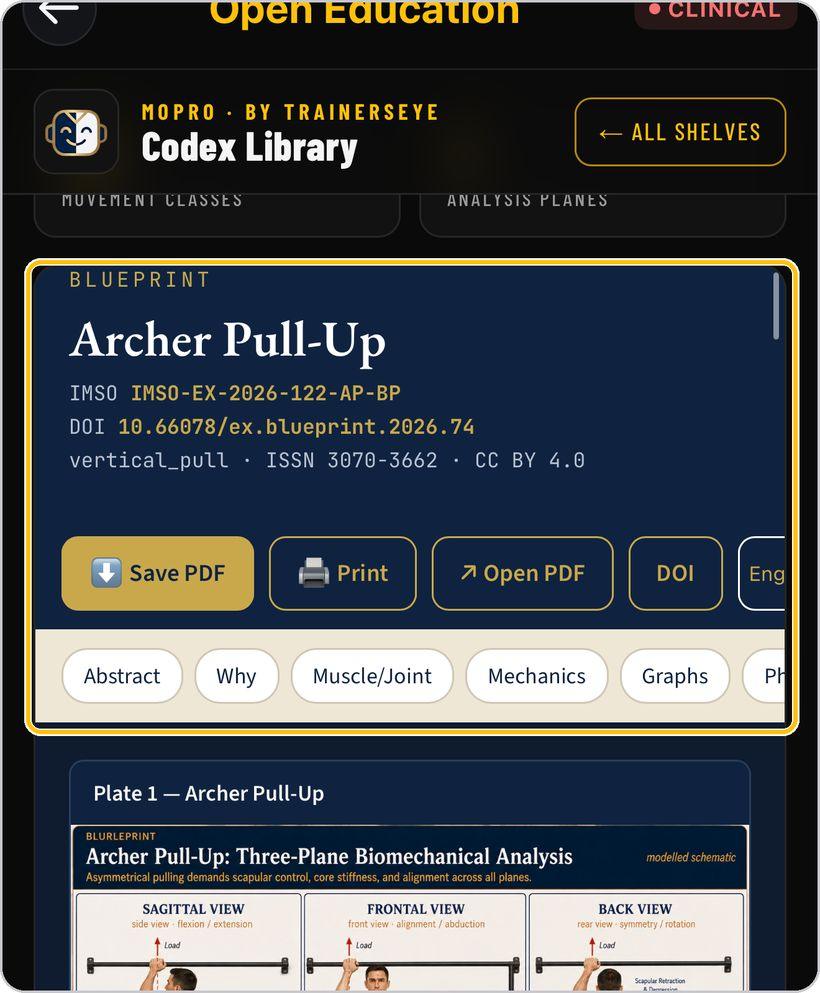
A blueprint opens on its record — Archer Pull-Up: IMSO ID, DOI, movement class, ISSN and CC BY 4.0 — with Save PDF, Print, Open PDF, DOI and the language switch, then the section pills: Abstract, Why, Muscle/Joint, Mechanics, Graphs, Phases and on. Plate 1 is the three-plane biomechanical analysis — sagittal, frontal and back views, annotated. The PDF runs to 28 pages, contents 1 to 13.

Articles
MoPro Codex · Articles — Perspectives in Movement Science, Vol. 1, 2026: editorially reviewed, co-authored, CC BY 4.0. Perspective and narrative-review pieces on where the evidence stops, what the practitioner should do at that boundary and how to tell when a number is lying. Each article is co-authored with a practising professional and carries a citable DOI on approval. 104 articles, 1.4k words each, 14 collections — Browse the catalog, or Editorial & how to cite.
Research Readings
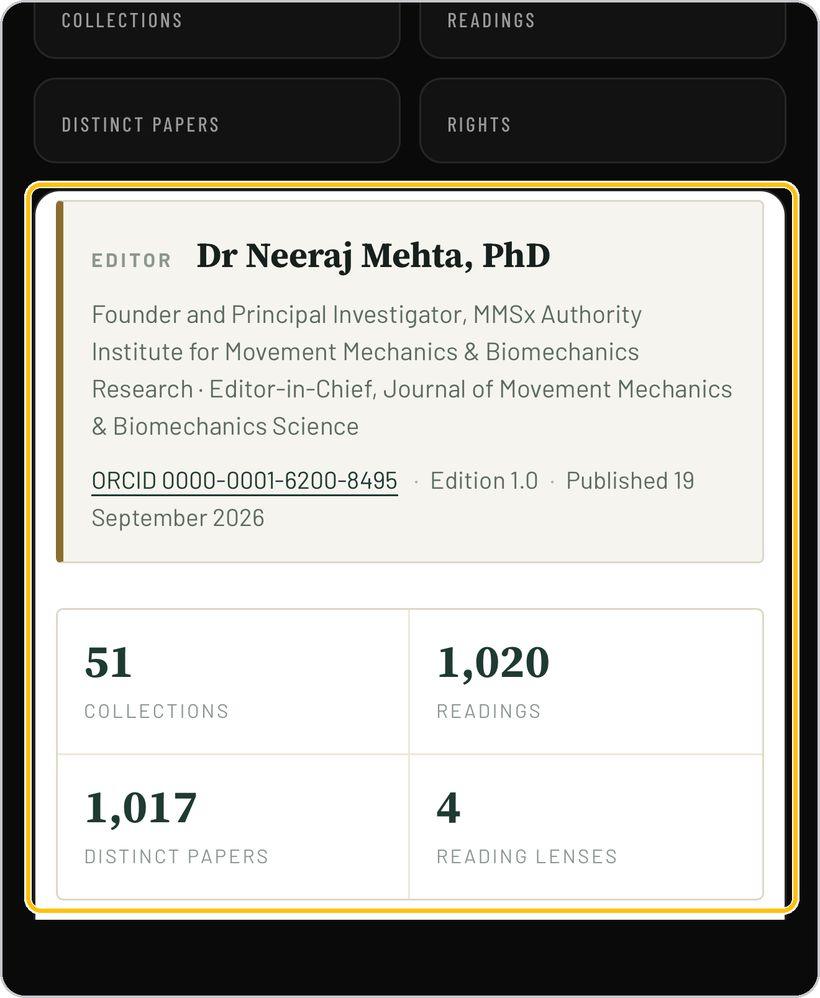
Editorial readings of open-licence movement science: the mechanics each study measured, the claims its data cannot carry, the decision it informs and the scope within which it holds. Fifty-one collections, 1,020 readings, 1,017 distinct papers and four reading lenses, edited by Dr Neeraj Mehta, PhD — Edition 1.0, published 19 September 2026.
Print, save and cite
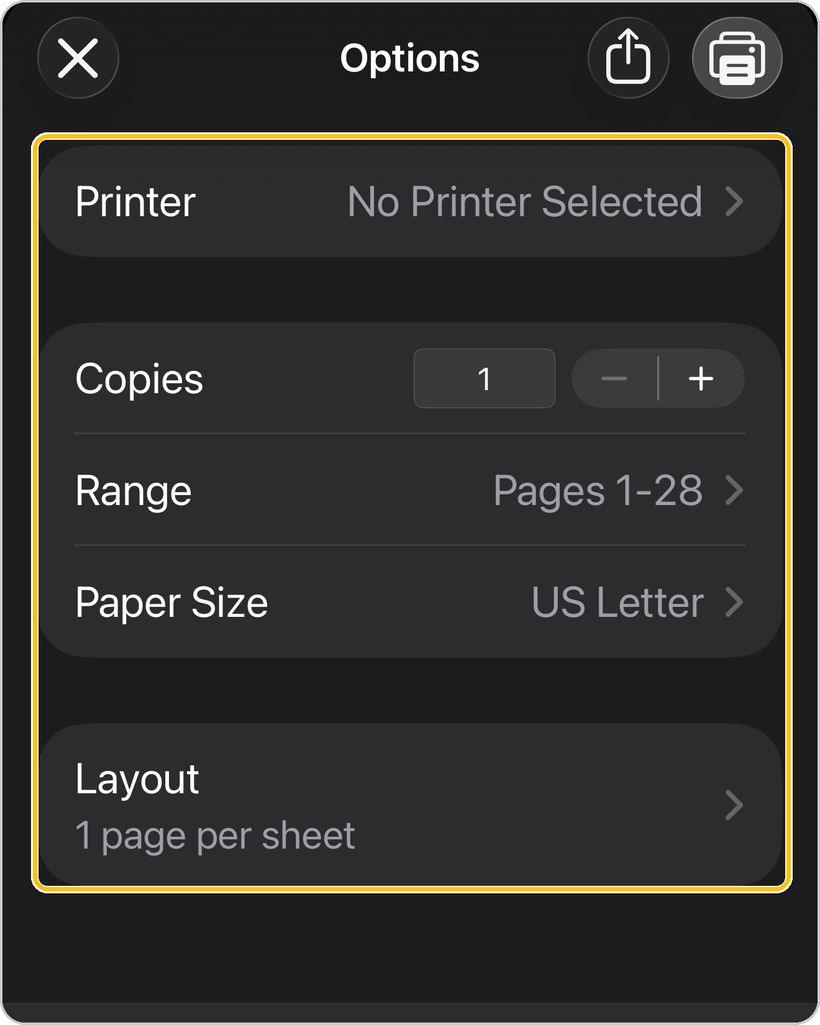
Print / PDF, Save PDF and Print open the phone's print sheet — pages, paper size, layout — to print or save to Files; Open PDF opens the file itself. Every document carries a DOI to cite (APA 7th), the free titles under CC BY 4.0.
You're ready
That's it. Open the Codex Library and tap a number to open its shelf.
Reading a comparison document
Every comparison prints as an MMSx Exercise Comparison Decision Document. Here is what each part of it means.
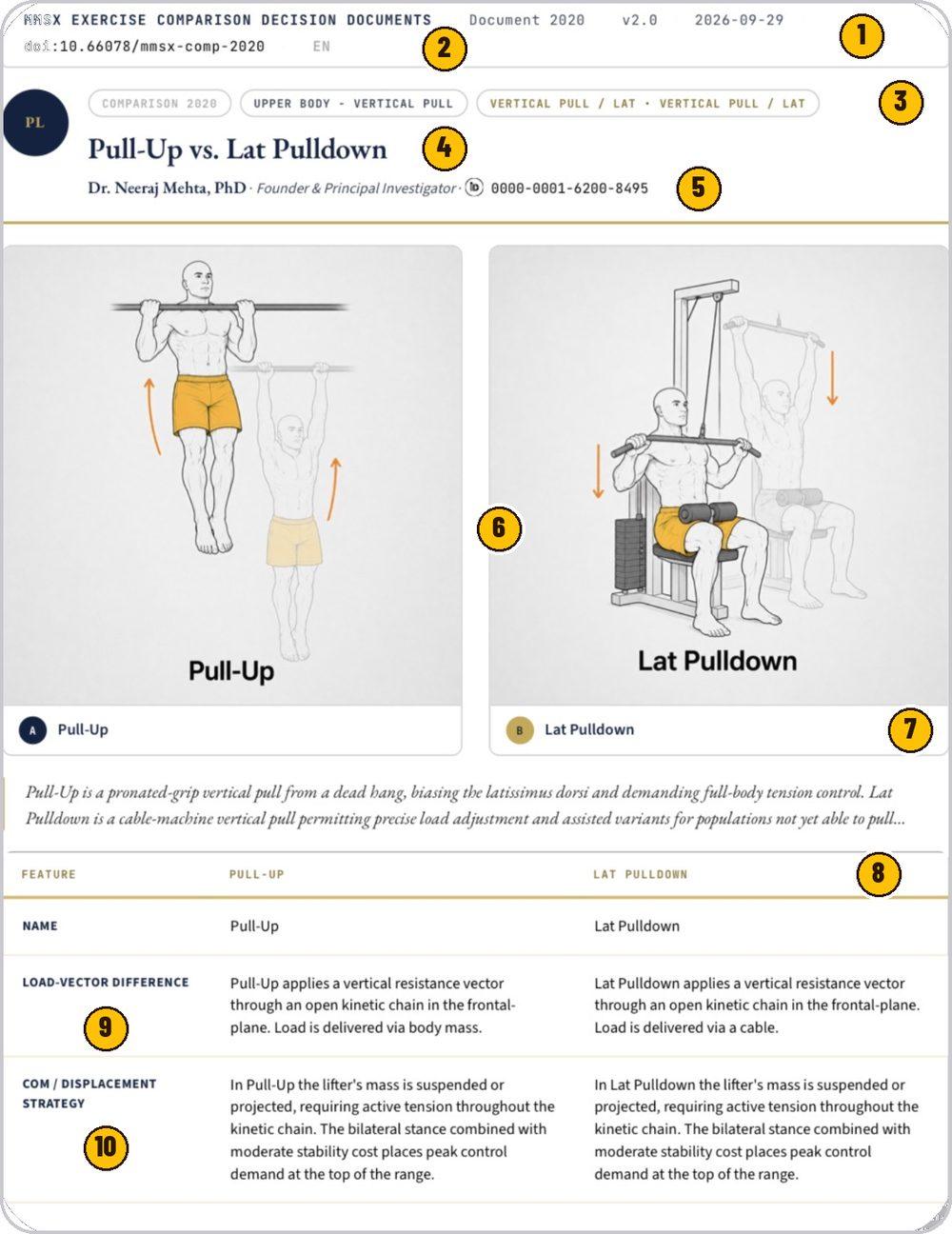
MMSx Exercise Comparison Decision Documents — the document number, version and date.
The citable DOI (doi:10.66078/mmsx-comp-…) and the language of this print.
The comparison number, the region and pattern, and the movement class of each exercise.
Exercise A vs. Exercise B.
The author, role and ORCID.
Each exercise drawn with its load direction.
What each exercise is, in a sentence each.
Feature · A · B — the comparison, row by row.
Where the resistance vector goes and how the load is delivered.
How the lifter's mass moves and where peak control demand falls — the table continues with torque, decision matrix and programming rules.
Open Education is part of TrainersEye
Support: support@trainerseye.com · trainerseye.com
MoPro Codex Library published by MMSx Authority Institute · Backed by MMSx Authority Institute
Reference material for movement professionals — modules, comparisons and blueprints are modelled decision support and educational content, not individual clinical assessment or medical advice; the GLP-1, peptide and hormone shelf describes evidence, rules and referral, not treatment.